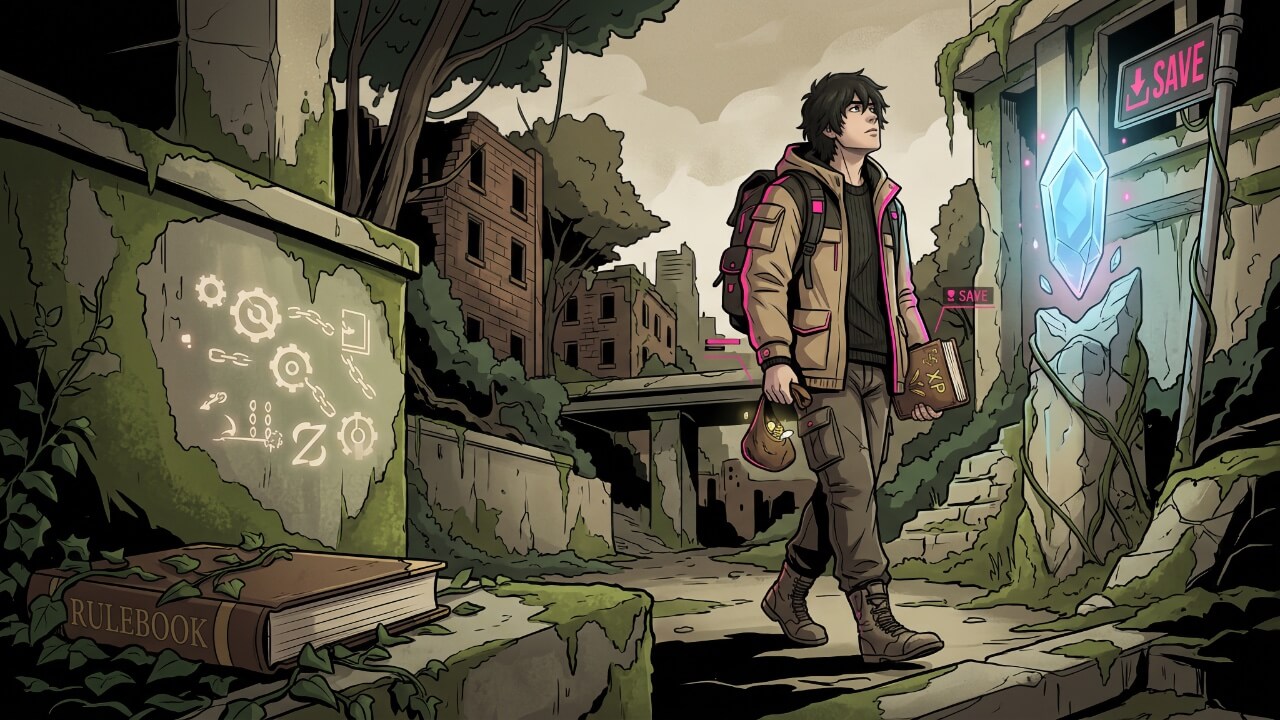
I've been thinking about how much life sometimes resembles playing a video game. Not in the obvious sense of collecting experience points or defeating enemies, but in the way games teach us lessons about rules, resources, and preparation.
1. The game only wants you to do things its way
Imagine fighting a tough boss. You've almost defeated it, and you're experimenting with different strategies. You try something creative that makes perfect sense, but it doesn't work. The game expects you to perform a specific action in a specific way. It doesn't matter if your approach is more creative, more interesting, or requires more skill. If the developers didn't design the game to support it, you're out of luck.
Life can be similar. You can spend years trying to build a business, experimenting with ideas and solving complicated problems, only to watch everything fail. Then you try something much simpler, like investing in property or shares, and things start working. You put your money somewhere sensible and wait.
It's almost frustrating how well the boring solution can work. Building a business is exciting, challenging, and creative. Investing and waiting can be considerably less exciting. Yet one succeeds where the other fails (not always, though).
Life doesn't necessarily reward the most creative solution. It rewards solutions that work within its rules.
Sometimes, instead of trying to find a more interesting way to play, we need to understand what the game actually rewards.
2. Sometimes, you earn infinite ammo
In Resident Evil and other games, completing the game and achieving certain objectives can unlock weapons with infinite ammo. This creates an interesting balance. On your first playthrough, ammo scarcity is part of the experience. Every bullet matters, and every encounter requires a decision.
But after playing the game several times, your priorities change. You've already proven that you can survive. Now you want to explore every room, find the items you missed, and experience things you couldn't focus on before. Infinite ammo lets you do that without worrying about every enemy.
Life works similarly. When we're young, we face many challenges for the first time: demanding jobs, complicated relationships, financial mistakes, and unexpected failures. These experiences can be exhausting, but they teach us valuable lessons. Over time, we develop the knowledge and confidence to handle situations that once seemed overwhelming.
Money follows a similar pattern. Early in life, we often have to make tough trade-offs and worry about every expense. But if we build financial security, we can eventually reach a point where we don't have to think about every dollar. It's not infinite ammo, but it's enough to change how we play.
The goal isn't necessarily to eliminate every challenge. It's to accumulate enough experience and resources that we can choose which challenges are worth taking on.
3. An autosave is just good organisation
Imagine you're about to fight a tough boss. The game automatically saves your progress, so if you die, you can try again immediately. Now imagine a game without autosaves or manual saving. If you fail, you might have to repeat forty minutes of gameplay just to get back to where you were.
Nothing about the boss has changed. You still know what you did wrong. Yet you have to repeat a lot of work you've already completed.
In real life, organisation is essentially an autosave system. Consider dealing with a complicated insurance policy, mortgage document, or tax return. You might spend hours understanding everything, but a year later, you'll probably have forgotten most of the details.
If you organise your documents, give your files meaningful names, and write down important decisions and their context, you create a checkpoint for your future self. The same applies to digital photos, research, and anything else you might need to find again.
Sometimes, the most valuable thing you can preserve isn't just the information, but the context around it. If you spend three hours researching a subject, write down what you learned. When you need that knowledge again in 12 months, you won't have to start from scratch.
A folder, a checklist, a spreadsheet, or a simple note can all serve the same purpose.
Good organisation is a way of saying "I already solved this problem once. I shouldn't have to solve it again."
We're all playing a game without seeing the rulebook
Video games have rules, resources, and checkpoints. So does life. The difference is that games eventually teach you their rules, while in life, although you can learn from books and other people's advice, you often have to discover them yourself.
Sometimes, you learn that the creative approach you wanted isn't the one that works. Sometimes, experience gives you abilities you didn't have before. And sometimes, you realise that a little organisation today can save you hours of frustration tomorrow.
Understanding these mechanics doesn't necessarily make life easier, but it can make us better at navigating it.
Perhaps the objective isn't to make the game easier. Perhaps it's to get better at playing it 😉